
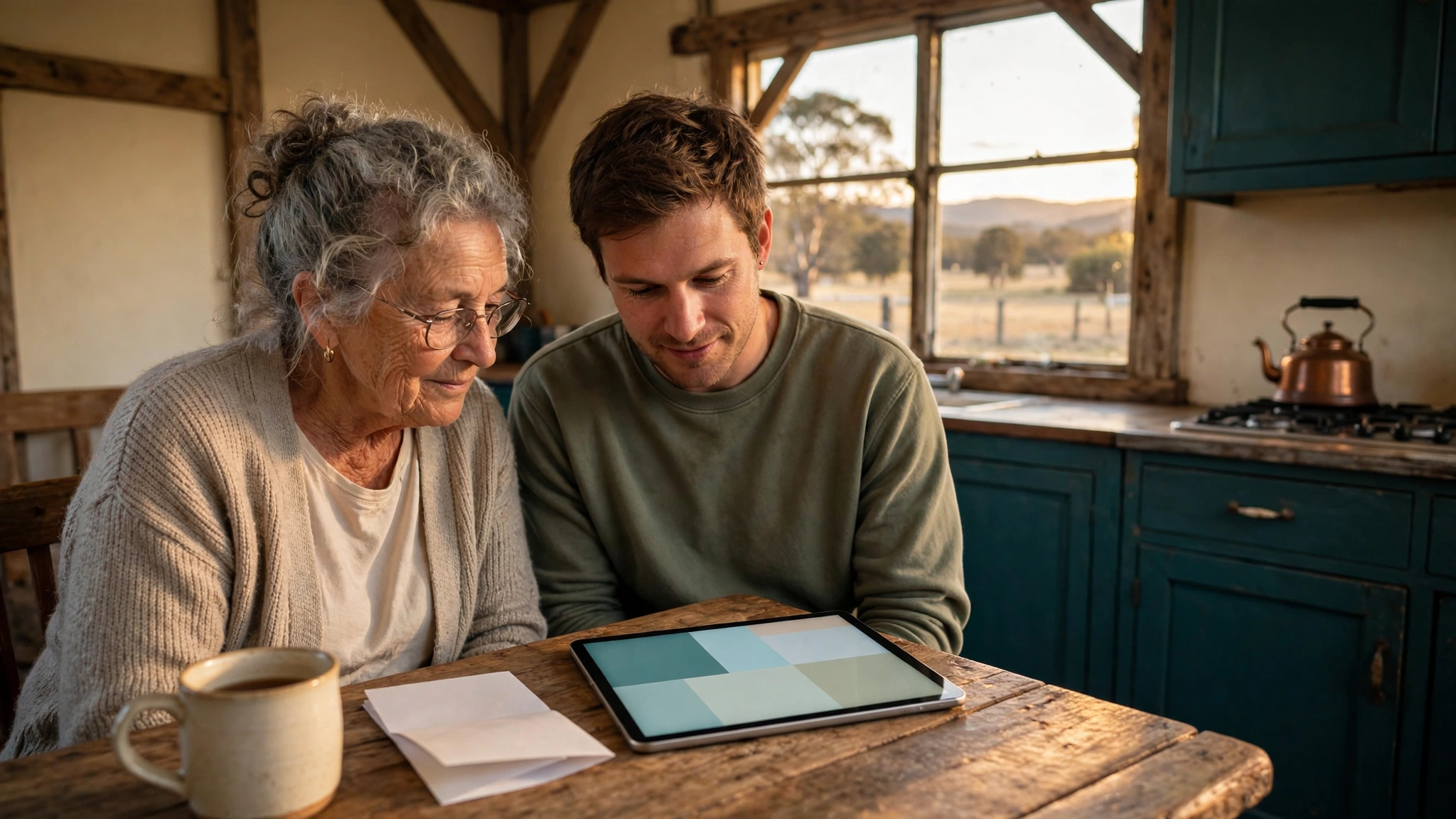
The consult can go well and still leave work unfinished. An older person leaves a regional clinic with a clearer picture of what was discussed. A family member has a few notes. Then the drive home begins, or the next home visit is already weeks away. Questions tend to arrive later, at the kitchen table, when the clinician is no longer in the room.
Distance is not only kilometres. It is the time between appointments, the relative who lives in another town, and the explanation that made sense in the consulting room but is harder to recall once everyday life resumes. Personalised digital health education is one way organisations might extend trusted learning into that space. It does not replace the visit or close a service gap on its own. It can give people a way to return to approved information between the services they already use.
What support beyond the consultation can mean
Beyond the consultation, in this sense, means continuing education after a conversation has ended. People can revisit clear, approved information at their own pace. A carer can look at the same resource. A home-care worker can refer to it on a later visit. The local GP, nurse, or community organisation remains the relationship that matters.
The same idea has a boundary. Digital education is not a virtual clinic, continuous monitoring, or after-hours clinical access. It is not diagnosis, treatment, triage, or emergency advice. If someone needs clinical judgement or urgent help, the right next step is still their clinician, their local service, or emergency care. A pathway that forgets that limit stops being trustworthy.
Distance as an education problem
Rural and remote ageing often stretches the gap between useful conversations. A single spoken explanation is easy to lose on a long trip home. A printed pack can sit unread, or become hard to follow when print is small and lighting is poor. Family members who were not in the room hear a shortened version. Community workers answer the same practical questions without a shared reference they can hand on.
None of that is a failure of the consult. It is a limit of one-off information. Follow-up education between appointments is most useful when it is planned, permission-based, and easy to return to, rather than another stream of content competing for attention.
An intentional sequence between existing services
Healthwise Digital Pathways is exploring an Identify, Personalise, Educate, Follow up, Engage model with partners. The sequence is a way to design learning around a real service touchpoint, not a claim of proven clinical effect.
Identify
Start with the audience need you can actually support. Which question keeps returning after a clinic visit, a home-care review, or a community program? Which cohort is ageing at home with long gaps between in-person contact? Identification is organisational work: name the touchpoint, the recurring confusion, and the people who will use the resource, including family carers and local workers.
Personalise
Personalise the pathway to the person and the setting. Language, pace, and format should fit health literacy, hearing or cognitive accessibility, digital confidence, and whether a family member will sit beside the screen. Personalisation here is practical matching, not a proprietary engine, and not a promise that every format already exists.
Educate
Education should be short, approved, and distinct from clinical instruction. Useful topics might include everyday movement and balance awareness, hydration and nutrition habits, preparing questions for a GP, home safety considerations, or a patient-paced walkthrough of a telehealth appointment. Every resource should make the limit obvious: this is information to understand and discuss, not a substitute for the clinician who knows the person.
Follow up
Follow up is a planned invitation to revisit, not a clinical check-in. With permission, an organisation might send a recap after a visit, point to a page on its website, or make the same resource available to a carer. Timing should respect real life, a few days after an appointment, or ahead of a known review. Follow-up education continues learning. It does not watch the person, and it does not claim around-the-clock coverage.
Engage
Engage means helping the education live inside existing relationships. A shared resource can give a GP, a home-care worker, a community group, or a family carer the same language. The aim is participation with local people and services, not a digital destination that pulls attention away from them. Engagement is useful when the next conversation is easier, not when a screen becomes the centre of care.
Complementing local clinicians, community organisations and carers
Digital pathways belong beside local care, not in front of it. Clinicians remain the source of clinical judgement. Community organisations, including Aboriginal Community Controlled Health Organisations, hold local knowledge and cultural safety that a generic resource cannot supply. Carers provide the presence that distance cannot digitise.
Used with care, education can take pressure off repeated explanations and give families a common reference between visits. Healthwise does not treat digital content as a way to close access gaps by itself. The model is under exploration with partners because fit, approval, and local trust have to be designed in, not assumed.
Design questions worth asking before you build
Organisations considering a pathway can start with questions rather than a platform list. Whose question is this answering, and who will actually open it after the visit? Who approves the content, and how often will it be reviewed? How will a carer or community worker use it between appointments? What happens when someone needs clinical advice or urgent help, and is that redirection impossible to miss? How will consent, privacy, and opting out work in practice?
Accessibility belongs in the same list. Hearing changes, cognitive load, small screens, and patchy connectivity are ordinary conditions in rural and remote work. So is the choice not to use a device at all, and to rely on a printed version or a supported conversation instead.
Communication options such as a website assistant for general enquiries, planned social education, or permission-based email can be discussed during co-design. They keep approved information findable. They are not clinical channels. Teams can compare options on the communication tools page and decide what fits their consent and review habits.
A conversation, not a finished system
Healthwise Digital Pathways is an Australian initiative exploring personalised digital education pathways for healthy ageing, with a particular interest in rural and remote aged care. The work is for organisations supporting older people, not a direct consumer product, and it is not presented here as a proven intervention.
If your team is looking at how learning might continue after the consult, without asking digital tools to do the job of local clinicians, carers, or community services, a co-design conversation is a reasonable next step. Visit Healthwise Digital Pathways to enquire about exploring a pathway with your organisation.
Trusted support across distance is still human support. Education can travel with people between visits. Care, judgement, and belonging stay with the people and services already in the community.
